
From Stardust to Algorithms
Cracking the Code of Our Universe, One Pixel at a Time

The cosmos captivated me from childhood, but it wasn't until 2019, stumbling upon a video about “how big our universe is”, that my curiosity truly ignited. Just minutes long, it left me wondering with the sheer immensity of it all. What does it mean to exist in a cosmos with mind-boggling emptiness between stars and galaxies sprawling across billions of miles?
Due to the speed of light, we are limited on how far into the universe our current technology can see, we call this the “observable universe”. Currently, this limit is about 93 billion light-years. But what exactly is a light year? It is the distance light travels in one year and since, it travels at an incredible speed, this number is huge, roughly 9.5 trillion kilometers or 5.8 trillion miles.
The universe had an explosive birth, the Big Bang. Picture this - a point of unimaginable density, erupting outwards, stretching space itself. Like ripples in a pond, this expansion continues even today, pushing galaxies further apart. So, these points at the edge of observable universe, they’re not actually 93 billion light-years away, but much farther — about 46.5 billion in each direction! It’s a mind-bending paradox.
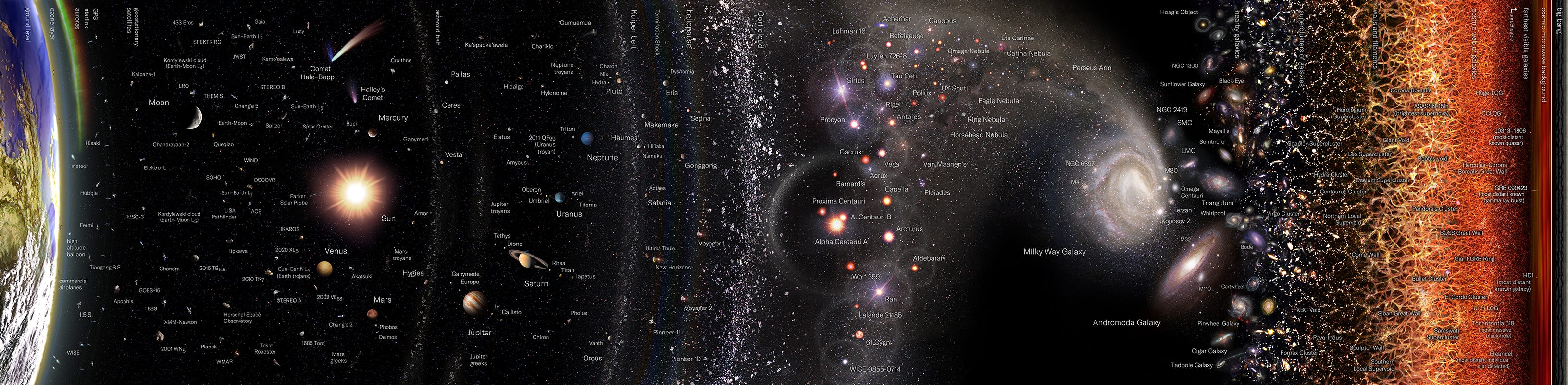
Those were some big numbers. Let’s try to put some perspective that a human brain can comprehend. Imagine our planet as a single grain of sand on a vast, cosmic beach. The observable universe, in this analogy, would be the entire beach itself – stretching for billions and billions of kilometers in all directions, filled with countless other "grains" (galaxies) like ours. It’s not only just about the number but what lies within and we are a part of it.
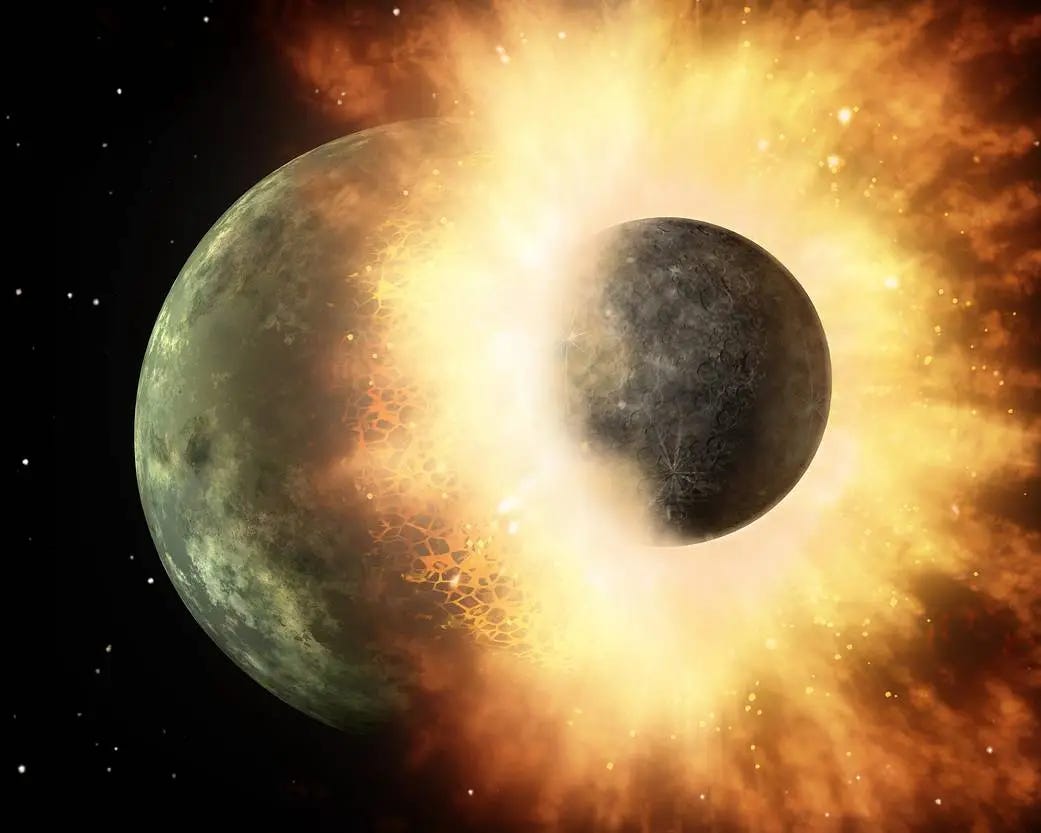
We live in a relatively peaceful part of the universe, in our Solar System. But it wasn't always peaceful all along. In its early ages, the Solar system was a chaotic vortex, and our Earth, a fiery cauldron bombarded by asteroids and meteorites, lacked the calming presence of its future companion—Moon. Around 4.5 billion years ago, a Mars-sized object, dubbed Theia, is believed to have collided with our young Earth. This colossal impact ripped a chunk from Earth's inner layer, flinging it into orbit. This debris eventually coalesced into our Moon. Next time you gaze at the Moon, remember that its cratered surface is a silent witness to Earth's violent past.
Yet, even amidst the devastation, life found a way. Deep within the primordial oceans, in the volcanic vents, single-celled organisms, dubbed extremophiles, thrived. These tenacious organisms, adapted to extremes of heat and pressure, laid the foundation for the astonishing diversity of life that would emerge in the eons to come. Earth's specific planetary features, like liquid water and a stable orbit, create a unique place for life, a precious occurrence within the vastness of space.
But as we gaze at the cosmos, a disquieting question echoes in the vast emptiness: Are we alone? Where is everyone? Questions like these are scary and spark immense curiosity at the same time.
It’s human nature to question everything. How do we know so much about the universe?
Driven by curiosity to understand the origins of life on Earth, humanity has pushed the boundaries of technology, peering deep beyond the celestial veil. We've planted our flag on the lunar surface, sent robotic explorers to traverse the rusty plains of Mars, and dispatched spacecrafts that have returned breathtaking panoramas of distant worlds, revealing nebulae shimmering in vibrant hues and icy moons dancing around gas giants.
Two of the spacecrafts are of a particular interest—Voyager I & II, the farthest man-made objects, have breached the Solar system’s edge. Each whisper we send, takes over a day to reach them. But they keep hurtling onwards, carrying a piece of our hopes and dreams, sniffing for alien worlds and sending back glimpses of a universe beyond our wildest imaginations.
Want to see their real-time journey? Follow their lonely trek across the stars right here on NASA’s JPL website.
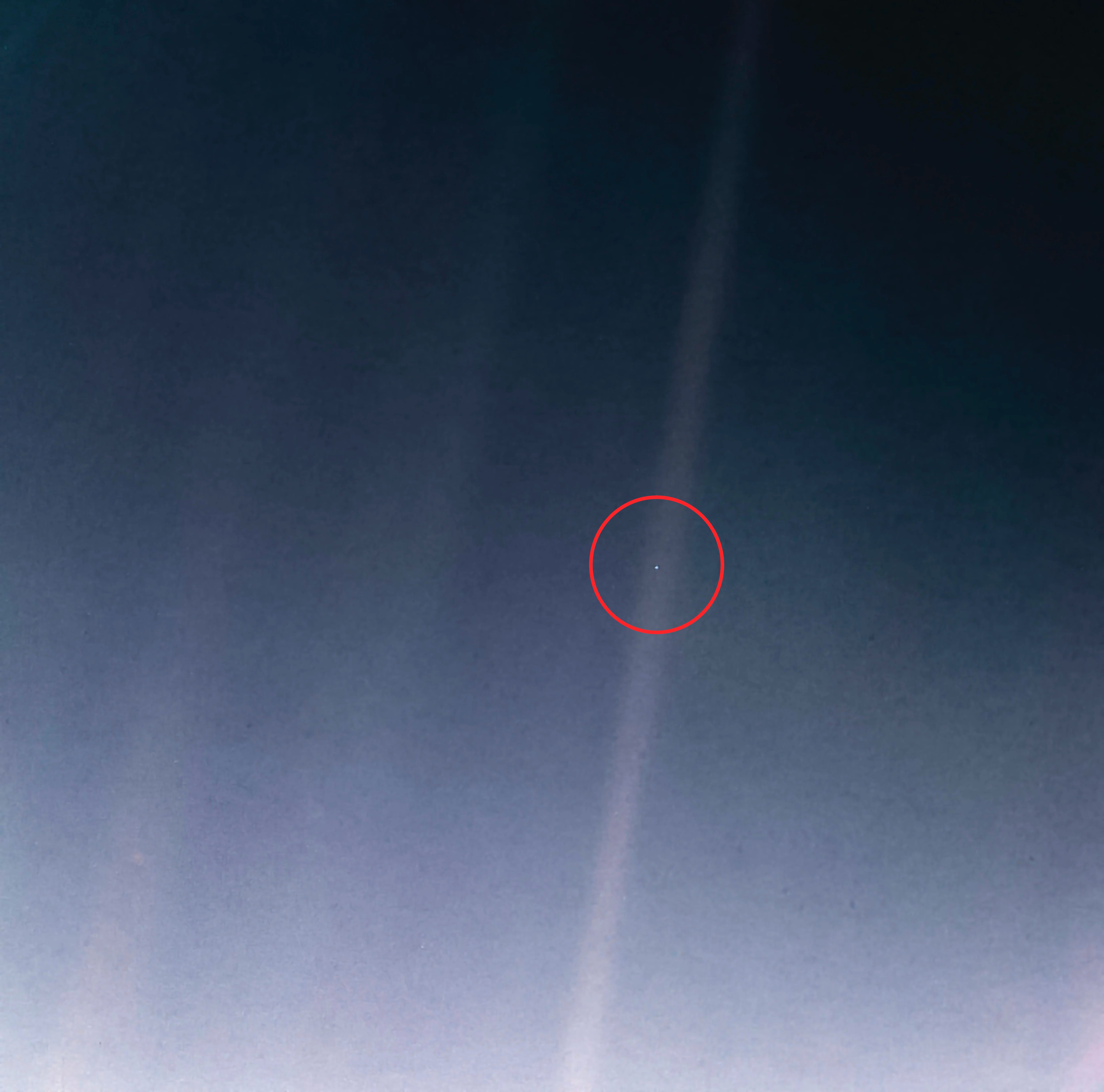
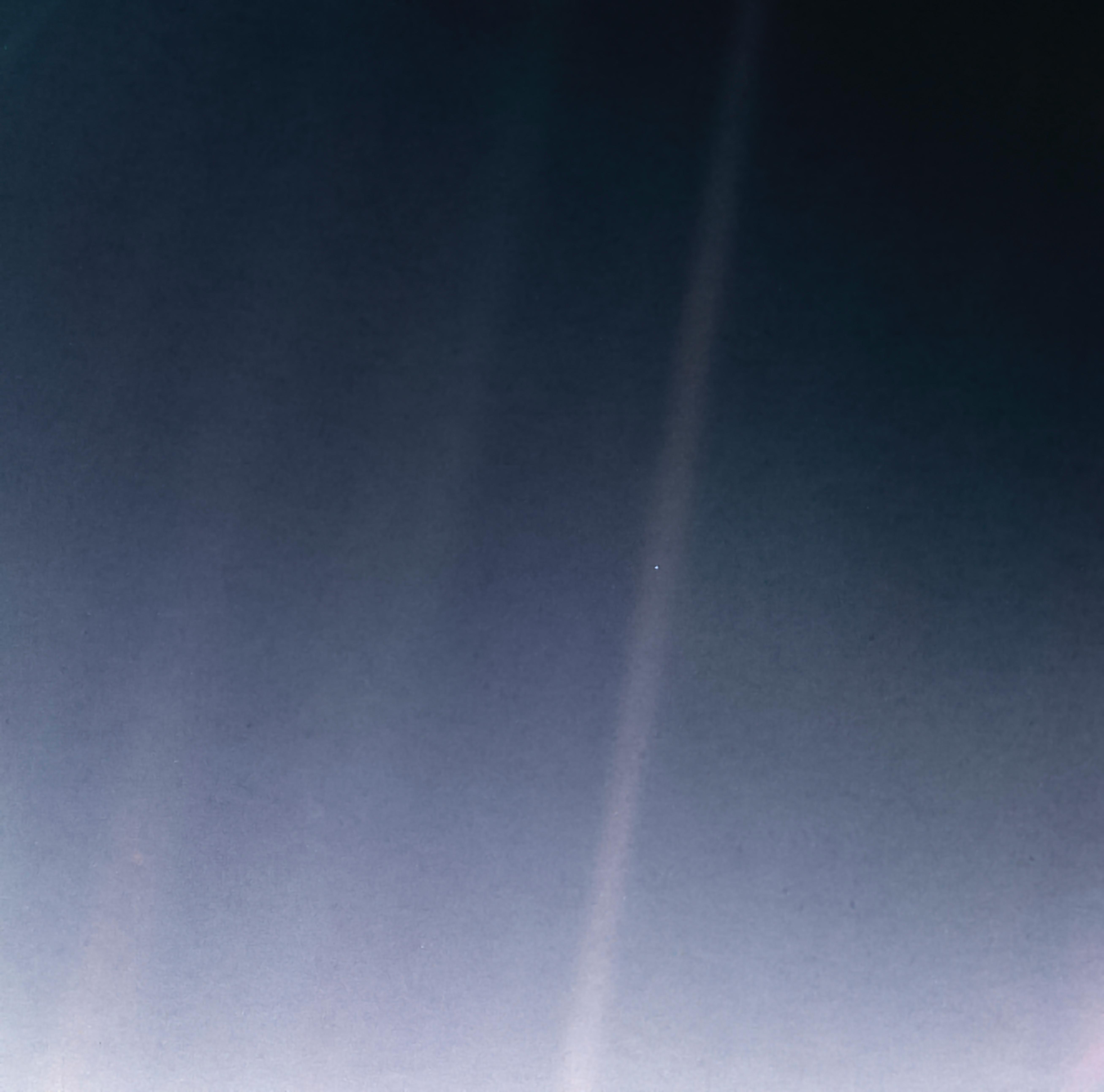
What do you think the tiny dot in this image is?
It’s us, the Earth, as captured by Voyager I from an unprecedented distance of 6 billion kilometers or 3.7 billion miles. Without a doubt, this is one of the greatest images of humanity ever captured. Zoom in on that pixel, and you'll find our cities, oceans, and the collective spirit of humanity. A humbling reminder of our place in the cosmos, nestled in the arms of the infinite.
The Rosetta Stone of the cosmos are lines of code, woven into the fabric of software. Software doesn’t just steer rovers across Martian plains; they decipher alien whispers from distant galaxies that light up our screens but remain silent to our ears. Without software, our cosmic ventures would be a blind stumbles, lost in the vastness of the unknown.
Imagine unraveling the secrets of nebulae, not by peering through telescopes, but by feeding data from millions of stars into complex algorithms. Software crunches these numbers, revealing celestial dances and patterns invisible to the human eye. Or take landing on the moon – a feat orchestrated by the ballet of code, calculating every thrust, every angle, with precision that transcends human reflexes. It's not just about crunching numbers and plotting courses. Software whispers back to us; it decodes the chatter of distant radio waves, translating the electromagnetic symphony of the cosmos into scientific insights. It analyses the textures of alien soils, searching for telltale signs of life, whispering clues in binary.
And here's the thing: this is just the beginning. As software evolves, so too will our cosmic reach. Already, AI is learning to analyse exoplanet atmospheres, searching for habitable havens. Soon, it might even guide autonomous spacecrafts, venturing deeper into the void than ever before.
Welcome aboard Cosmicode. My name’s Kasi. By day, I wrangle code, crafting software that could one day power us to the stars. By night, I'm an avid stargazer, lost in the cosmic ballet of planets and nebulae. And on weekends? Well, let's just say the pixelated battles get epic!
Think of Cosmicode as your personal wormhole to a universe where:
We crack open mysteries from across the universe and blast off on the latest space news, dissecting discoveries with the precision of a laser pointer and the enthusiasm of a rocket launch. 🚀
We crack open the code behind cosmic tech, exploring how software fuels our interstellar adventures, from rovers on Mars to telescopes peering into the abyss.
We occasionally dive into the depths of gaming worlds, where lasers meet logic and aliens get pixelated. (Because hey, even astronauts need to unwind!)
So buckle up, this newsletter is your weekly rocket ride of cosmic wonder, technological marvels, and maybe a splash of pixelated battles. We'll explore the cosmos, one line of code and joystick flick at a time. Speaking of curiosity, remember the video, that sparked my obsession with the cosmos? Watch it, and then get ready to launch!